From "People Watching Devices" to "System-Managed Machine Rooms": What Is the Data Center Operating System Changing?
Operations Efficiency Up 45%, Electricity Costs Down 30%, ROI Cycle Less Than Two Years
The original customer examples describe operational efficiency gains of 45%, electricity savings of 30% and payback in less than two years. DCOS, the Data Center Operation System, brings equipment, assets, capacity and operating processes into a shared management layer.
Racks, servers, cables and cooling are only part of a data center. As equipment numbers, vendor diversity, distributed locations and energy costs grow, unified operations become essential.
A data center needs an operating layer
Computers and servers have operating systems, while cloud platforms have resource scheduling. DCOS brings a comparable coordinating layer to the physical data center: equipment health, asset records, rack capacity, power, temperature, maintenance information, risks and automated workflows.
Improve efficiency and reduce management costs
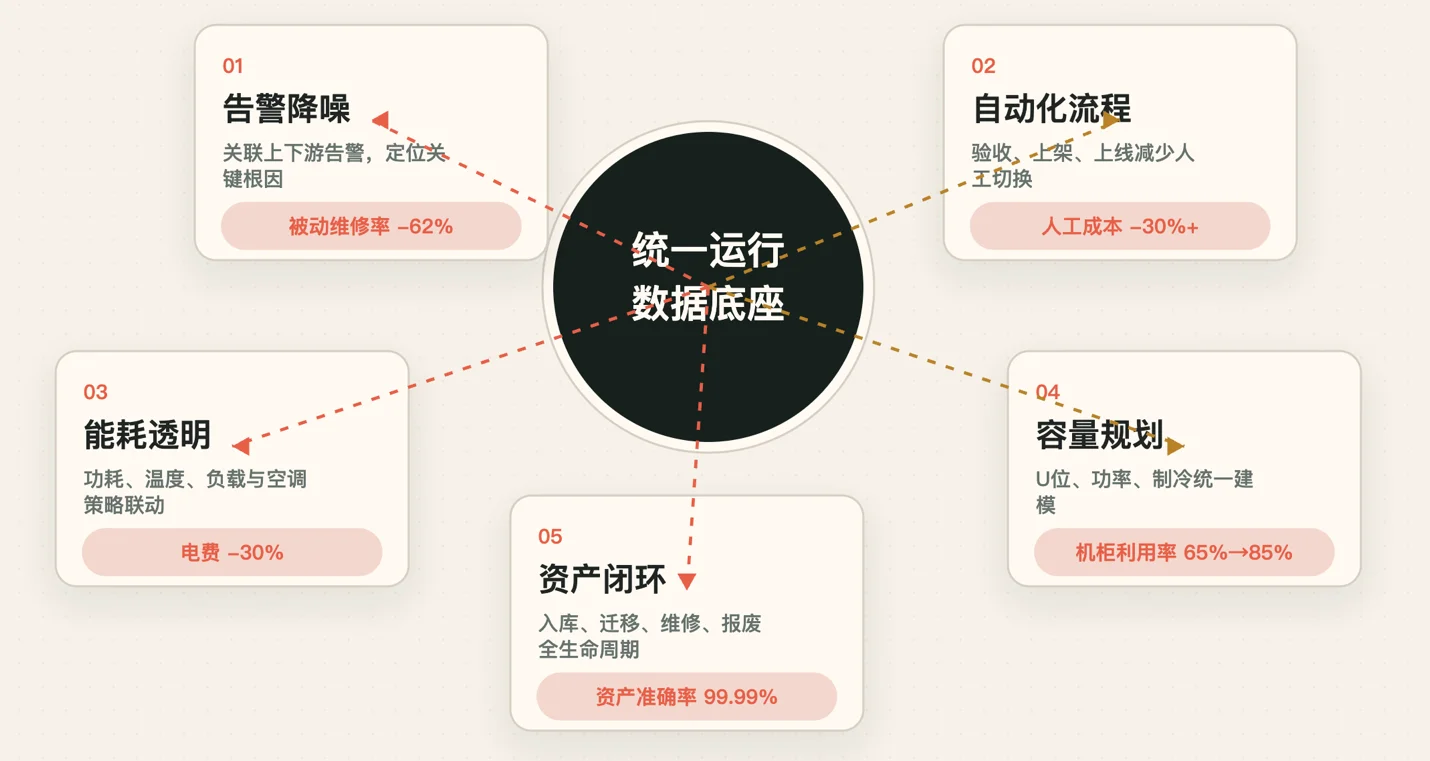
Centralized monitoring and root cause analysis connect upstream and downstream alerts so teams can focus on the underlying fault. In the securities customer example, reactive hardware repairs fell 62% and manual incident work fell 60%. A manufacturing customer standardized receipt, installation and deployment workflows and reduced labor costs by more than 30%.
Optimize energy use
DCOS collects device power, inlet and outlet temperatures, rack power and space usage. One example increased rack space utilization from 50% to 80% and reduced per-rack costs by approximately 30%. For illustration, a 30% reduction on an annual electricity bill of RMB 5 million saves RMB 1.5 million. The article places typical project investment at RMB 1–2 million and reports payback within 18 months for many projects.
Improve rack utilization
A capacity model combines rack units, power, temperature, equipment type and business importance to recommend placements. Another cited customer increased utilization from 65% to 85%, reducing its need for rented racks by approximately 30%.
Reduce asset waste
Track equipment through receipt, installation, movement, repair and retirement. The article reports asset accuracy reaching 99.99% in customer deployments. In an SSD lifecycle example, identifying individual drives at end of life allowed replacement of one or two drives instead of an entire batch, reducing the maintenance cost to one tenth.
Move toward intelligent operations
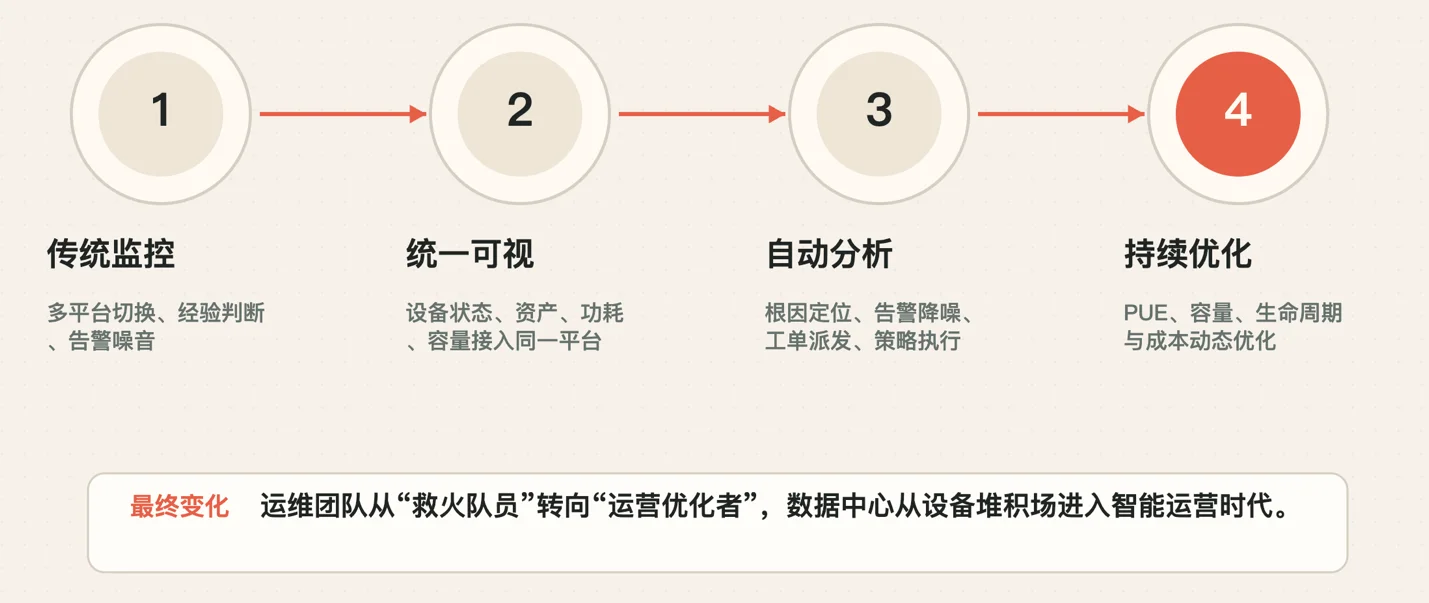
- Digitization: Measure fan speeds, health, power, temperature and capacity.
- Automation: Reduce alert noise, assign work orders and execute configured policies.
- Intelligence: Assess failure risks, optimize PUE, estimate equipment lifecycle and identify capacity bottlenecks.
DCOS helps teams shift from emergency repairs toward ongoing operational improvement, using a shared view of the infrastructure and its costs.