
Business Service Intelligent Monitoring & AIOps Platform
View service health, fault impact, and root causes from a business perspective, reducing alert noise.
Target Users: Operations Directors, SRE Teams, Application Operations Leads, IT Managers
Need to See Impact Earlier Before Business Interruption
Traditional monitoring tools typically display alerts by resource type. Servers have server alerts, networks have network alerts, databases have database alerts. O&M teams see many alerts but may not be able to quickly determine which alert is most important, which business it affects, or where the root cause may be.
Many alerts, unclear priorities, unknown impact scope
From "Viewing Alerts" to "Viewing Business Impact"
What Problems Does SmartBSM Mainly Solve
Too Many Alerts, Unclear Priorities
Multi-system and multi-resource simultaneous alerts make it difficult for O&M teams to determine priorities and real impact
Business Impact Not Visible
After device, network, database, or middleware anomalies, it is difficult to quickly determine which business systems are affected
Slow Root Cause Localization
O&M personnel need to investigate across multiple systems, relying on experience for judgment, with long processing time
Resource Relationships Unclear
Lack of unified topology between applications, hosts, databases, storage, network, and business services
Monitoring Data Disconnected from Business
Many infrastructure metrics but cannot directly indicate whether business services are healthy
Insufficient Intelligent Analysis Capability
Lacking alert correlation, anomaly identification, impact analysis, and risk prediction capabilities
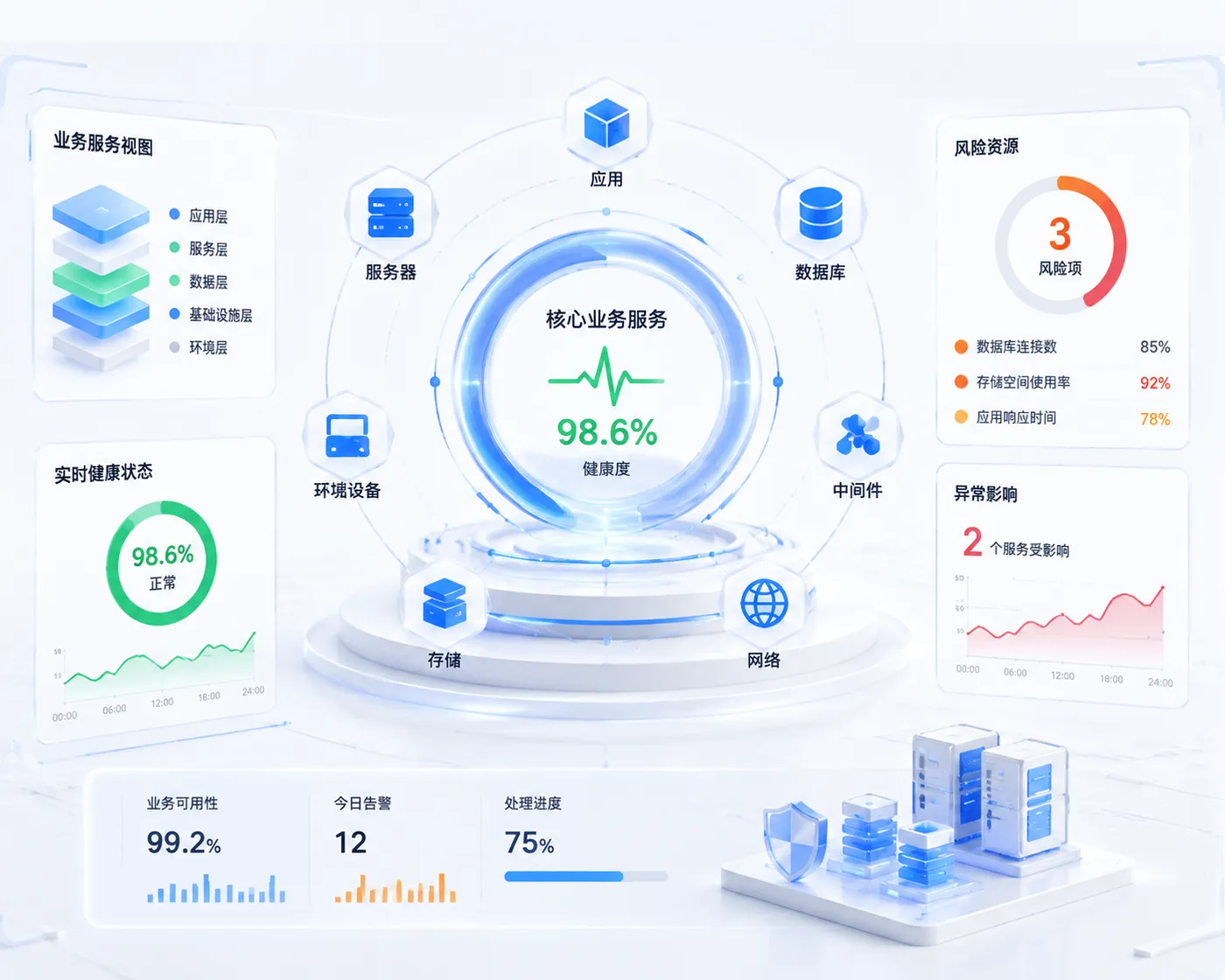
From Resource Monitoring to Business Service Monitoring
SmartBSM can establish service views around business systems, associating applications, servers, databases, middleware, network, storage, and environment devices with the same business service. O&M teams can understand whether core businesses are normal through business health views, which resources have risks, and which anomalies may affect service availability.
- Establish service views around business systems
- Real-time understanding of whether core businesses are normal
- Identify which resources have risks
- Let management and O&M teams understand IT status using the same language
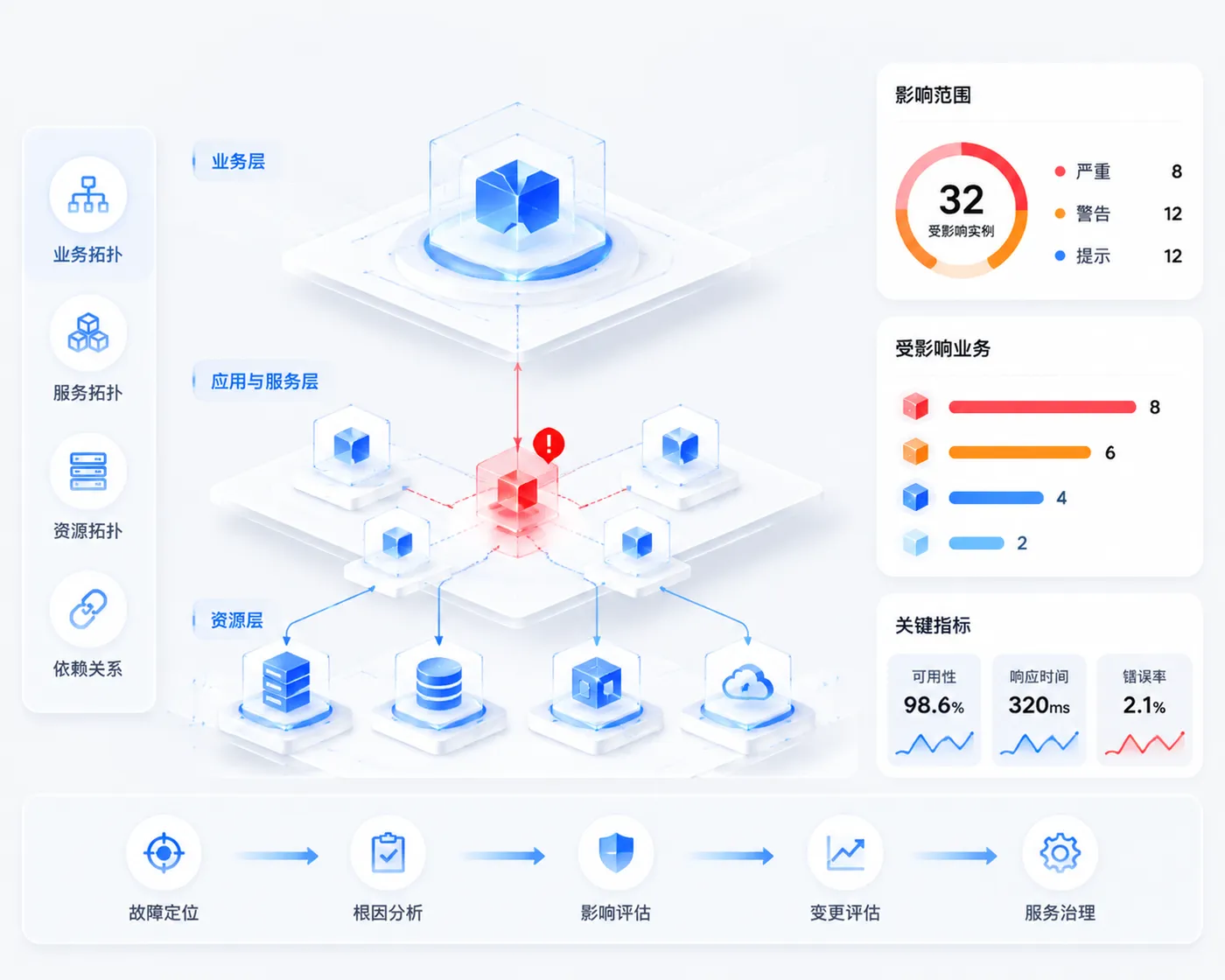
Automatically generate topology for business
SmartBSM supports business topology and resource relationship views, helping enterprises see the connection between business systems and underlying resources. When anomalies occur, the platform can assist in judging the impact scope and help O&M teams more quickly identify affected businesses, related resources, and upstream/downstream dependencies.
- Application topology, service topology, resource relationship topology
- Upstream/downstream dependency relationship visualization
- Assist in judging impact scope during anomalies
- Support fault location, change assessment, and service governance
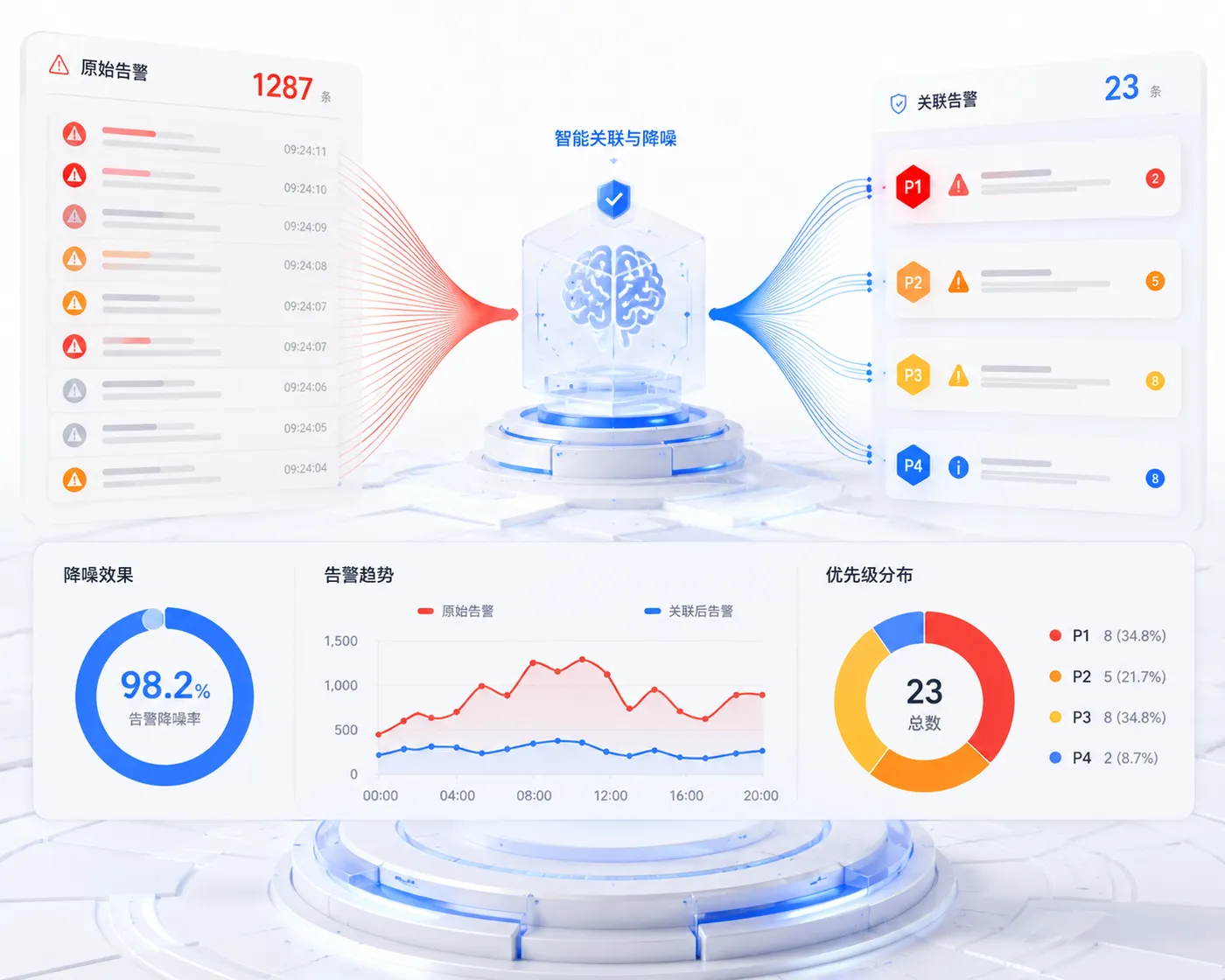
Alert Correlation & Intelligent Noise Reduction
In large data centers, one fault often triggers multiple alerts. SmartBSM can perform correlation analysis on alerts, merging and sorting alerts on the same event chain to help O&M teams prioritize attention to anomalies that truly affect business.
- Alert correlation, merging, and sorting
- Alert noise reduction, reducing duplicate notifications
- Alert priority identification
- Reduce alert fatigue and let key problems be discovered earlier
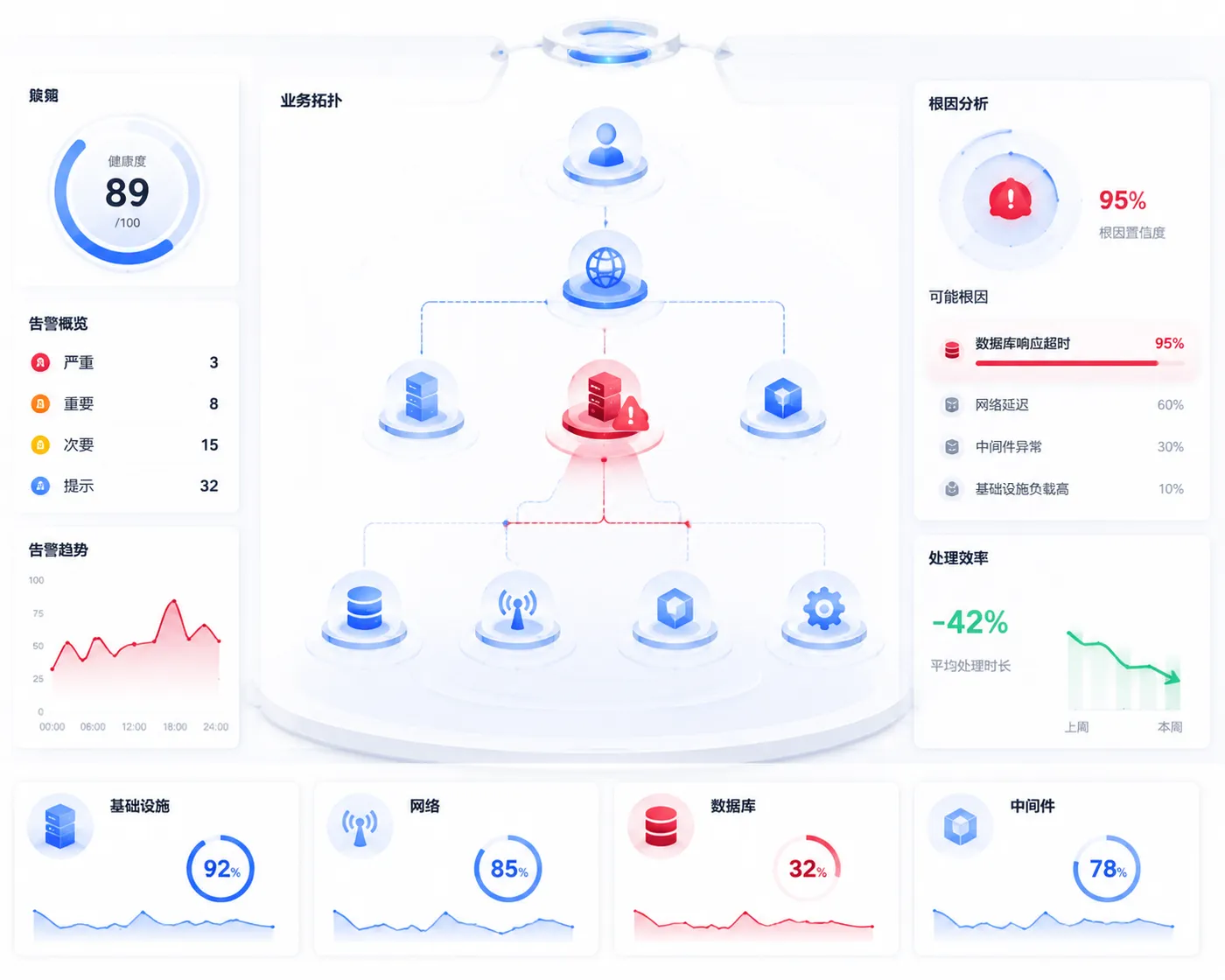
Root Cause Analysis & Fault Location
Slow fault location is usually not because of lack of data but because data is scattered across too many systems. SmartBSM assists O&M teams in root cause analysis through business topology, resource relationships, alert correlation, and historical data, determining whether problems may come from infrastructure, network, database, or middleware.
- Based on topology relationships and alert correlation
- Determine problem source: infrastructure / network / database / middleware
- Reduce blind investigation and cross-system switching
- Improve fault handling efficiency
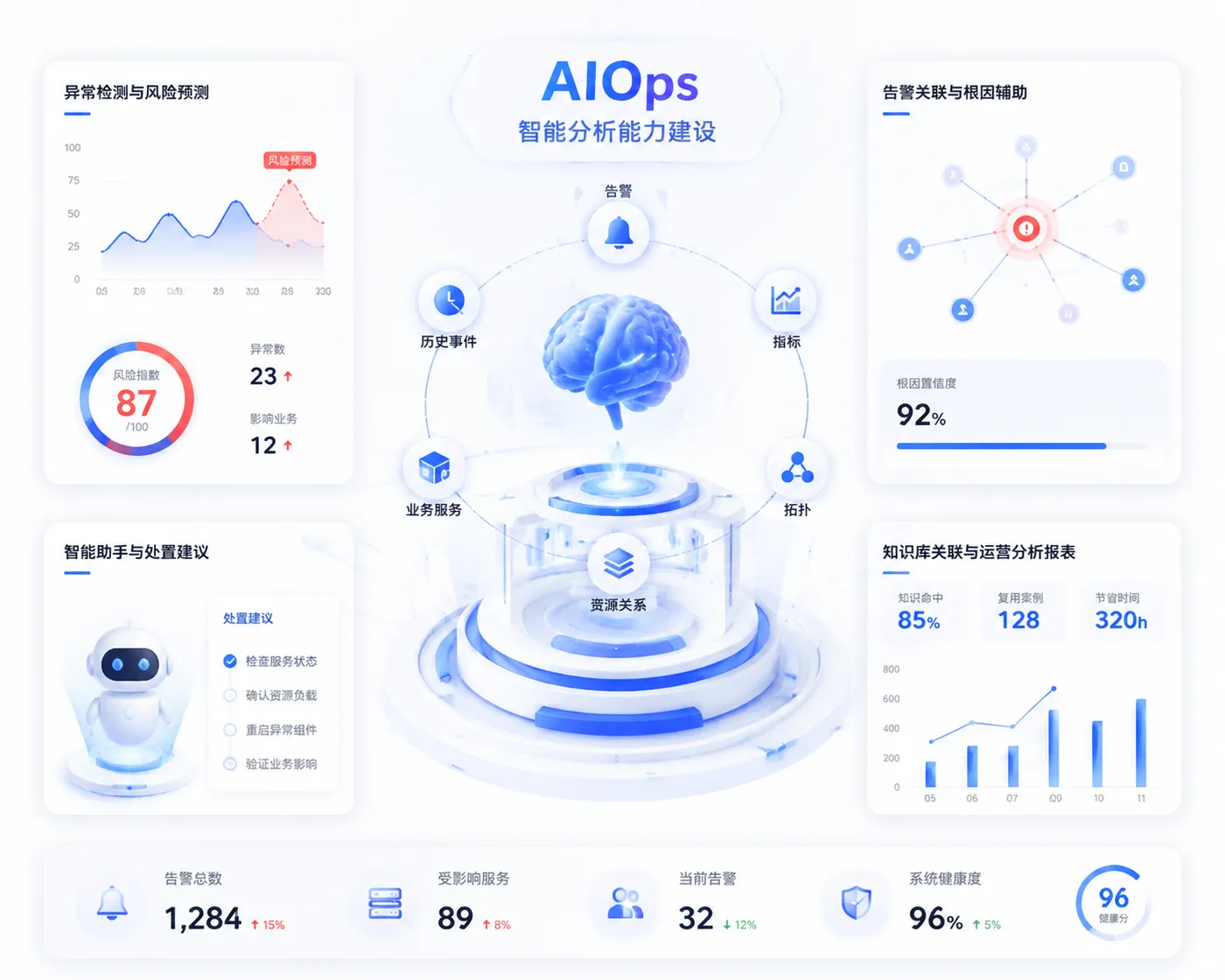
Building AIOps Intelligent Analysis Capabilities
The value of AIOps lies not in stacking algorithms but in helping O&M teams discover anomalies faster, judge impact more accurately, and locate causes more efficiently. SmartBSM combines alerts, metrics, topology, resource relationships, business services, and historical events to provide a foundation for intelligent analysis.
- Anomaly detection and risk prediction
- Alert correlation and root cause assistance
- Intelligent assistant and handling suggestions
- Knowledge base association and operational analysis reports
Five Core Capabilities, Building a Business Service Monitoring System
Business Service Monitoring
Business Topology
Intelligent Alert Analysis
Root Cause Analysis
Intelligent O&M
Synergy with DCOS & iDCOS
The three products cover a complete O&M chain from hardware layer to business layer: DCOS provides underlying data, iDCOS handles workflow management, and SmartBSM focuses on business analysis.
DCOS
Hardware Layer Data
iDCOS
Management Layer Data
SmartBSM
Business Layer Analysis
Covering Multiple Business Service Support Scenarios
Core Business System Health Monitoring
Applicable to core systems of banks, securities, hospitals, government/enterprise, telecom, and large enterprises, displaying health status centered on business services.
Alert Noise Reduction & Priority Identification
Applicable to enterprises with large alert volumes, many duplicate alerts, and many derived alerts, merging related alerts and prioritizing key issues.
Fault Root Cause Localization
Applicable to enterprises where fault investigation relies on manual experience and cross-system searching takes a long time, using topology relationships to assist in locating anomaly sources.
Business Impact Analysis
Applicable to enterprises needing to quickly determine fault impact scope, judging affected businesses when servers, network, storage, etc. have anomalies.
Major Event Support
Applicable to scenarios such as transaction peaks, holidays, releases, exam registration, hospital support, etc., with focused monitoring of key business service status.
AI Computing Business Service Support
Suitable for AI computing services, cloud phones, cloud gaming, and GPU resource pool scenarios, linking computing infrastructure with business service health.
FAQ about SmartBSM
Traditional monitoring software displays alerts by resource type, showing server alerts, network alerts, and database alerts separately. SmartBSM is business service-centric, associating alerts with business impact to help operations teams identify which anomalies truly affect core business.
SmartBSM can integrate with data sources such as infrastructure monitoring, network monitoring, application monitoring, and log systems. Combined with CMDB, it establishes relationships between business and resources for business-centric fault analysis.
SmartBSM uses alert correlation analysis to merge and sort derived alerts on the same fault chain, determining alert priority based on business impact and resource relationships, helping operations teams prioritize handling anomalies that truly affect business.
Yes. SmartBSM supports on-premises deployment with single-node and cluster deployment modes. You can choose the appropriate deployment based on enterprise scale, supporting physical machines, virtual machines, and containerized deployment.
Contact us through the "Book Demo" button on the page, or call our customer service. Our sales and technical team will provide customized solutions and pricing based on your business scenario, monitoring status, and construction goals.
View IT Risks from a Business Perspective
SmartBSM helps enterprises elevate the O&M perspective from the resource layer to the business layer, reducing invalid alert interference, faster judgment of fault priorities, more accurate anomaly source localization, and enabling different teams to collaborate uniformly around business services.