AI Data Center Capacity Planning Guide
GPU Cabinet, Power, Cooling & Capacity Management
Why Traditional Capacity Planning Cannot Support GPU Infrastructure
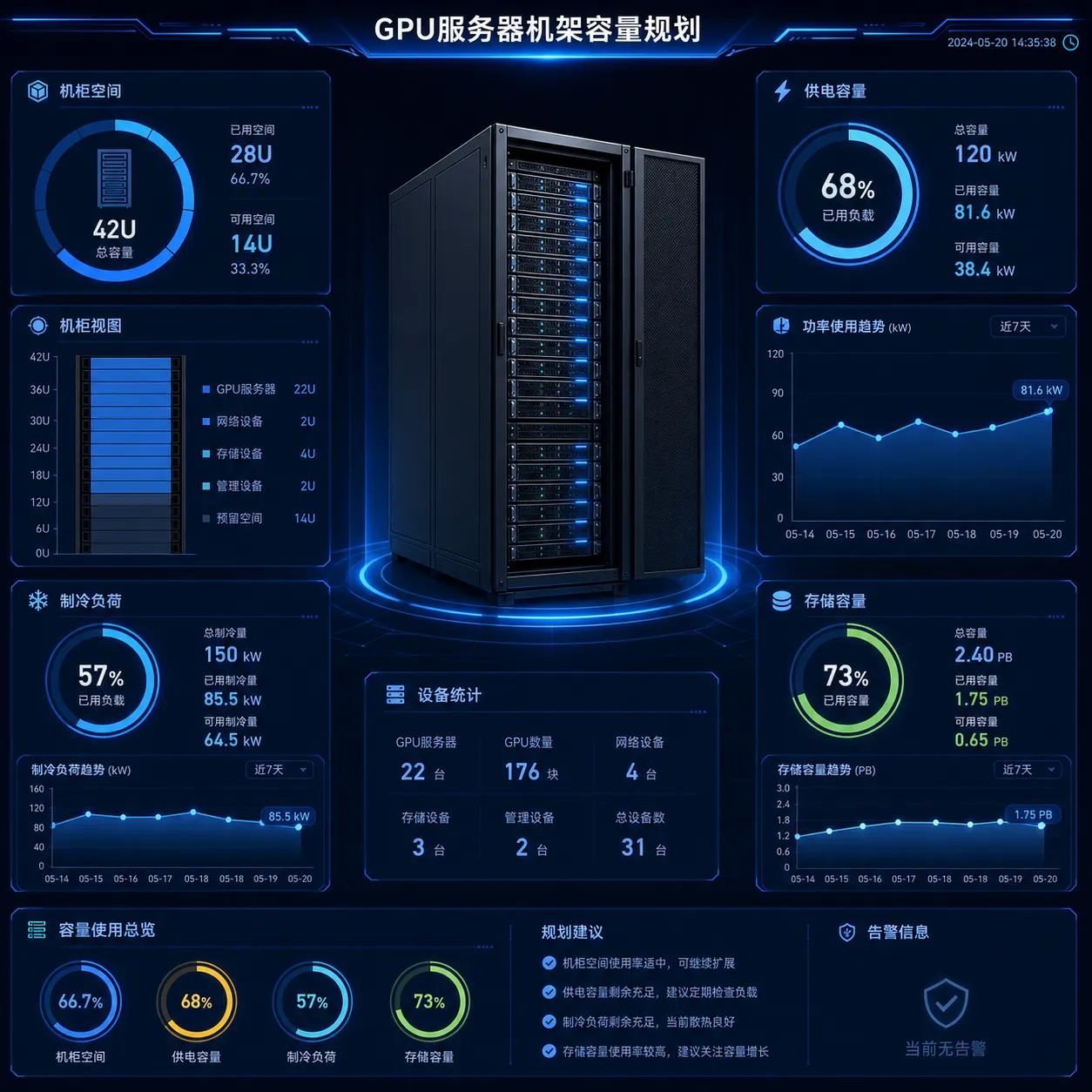
AI data center capacity planning is becoming a priority issue for enterprises building AI computing centers, deploying GPU servers, and expanding AI infrastructure. As GPU power consumption continues to rise, traditional planning methods based on available rack units, equipment quantity, and nameplate power are struggling to accurately determine whether a new device can truly be deployed. A rack may still have available U positions, yet lose actual deployment value due to insufficient power margin, limited local cooling capacity, insufficient high-speed network ports, or storage throughput that cannot meet requirements.
Key Dimensions of GPU Capacity Management
- Cabinet Space Management,Power Capacity Assessment,Cooling Capacity Analysis,Network Port Capacity,Storage Throughput,Equipment Weight Limits,Redundancy Strategy,Business Requirements
Core Capacity Planning Capabilities
This guide systematically introduces key methods for AI data center capacity planning, including how to establish accurate asset and rack U-position baselines, how to manage rated power, real-time power, peak power, and predicted power consumption, how to evaluate GPU equipment power, temperature, network and storage dependencies, and how to verify device deployment plans through intelligent pre-racking.
Intelligent Pre-deployment & Future Expansion
You will also learn how to establish device profiles, workload profiles and deployment profiles, how to simulate baseline, expected and high-growth scenarios, and how to determine the latest capacity expansion decision time based on construction cycles, capacity reservations and business priorities.
How CloudSino Supports AI-Era Capacity Management
CloudSino connects assets, racks, power, cooling, energy consumption, approvals, changes and business requirements through DCOS, iDCOS and SmartBSM, forming a continuous capacity assurance closed loop from field data collection, capacity calculation, pre-racking evaluation, production verification to future prediction.