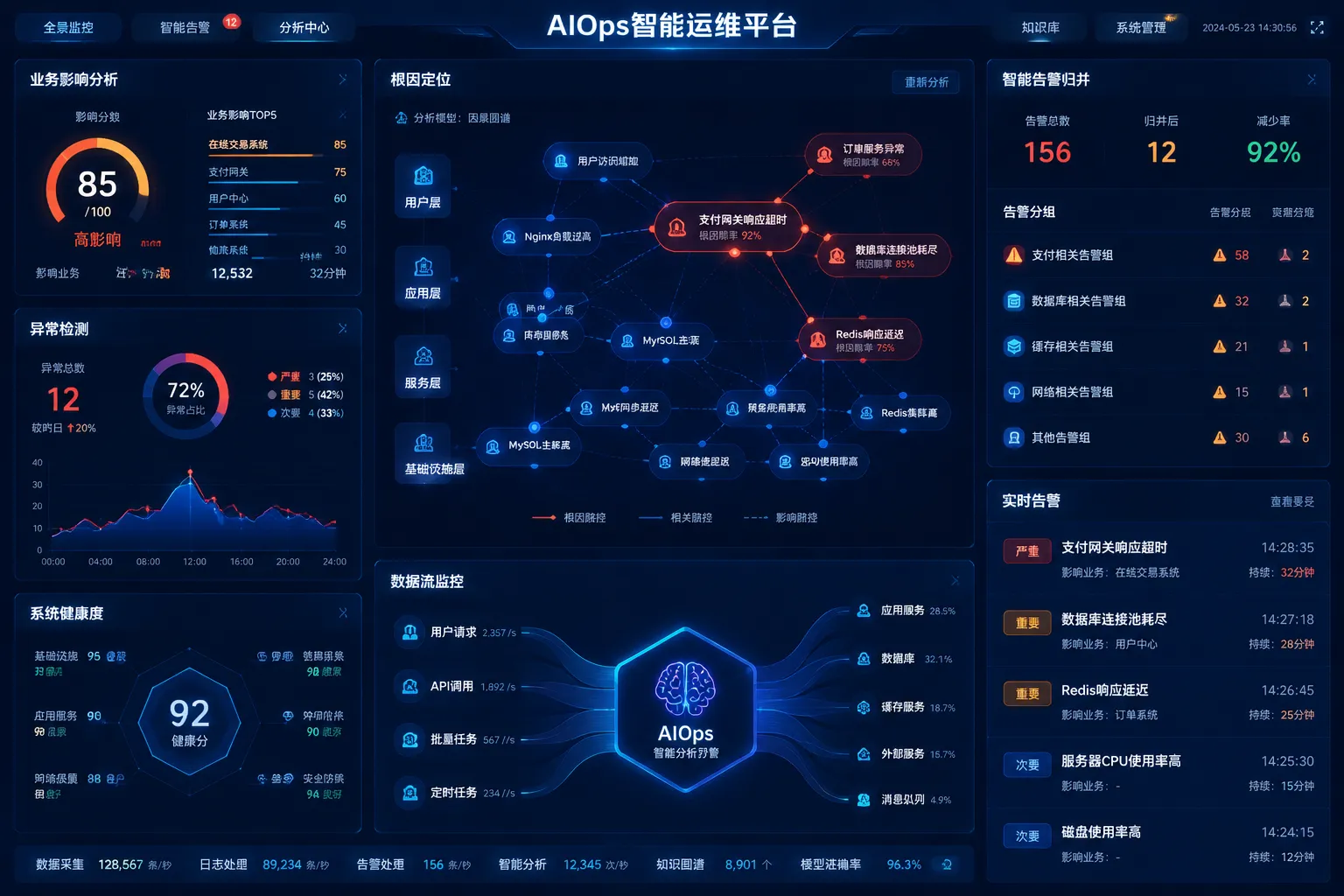
Business Service Intelligence Guide
From Infrastructure Monitoring to Business Impact & Root Cause Analysis
Why Enterprises Need Business Service Intelligence
Business service intelligence is helping enterprises evolve from the technical perspective of "whether resources are normal" to the operational perspective of "whether services are healthy, what business impact is occurring, and where the fault originates". Traditional infrastructure monitoring can continuously collect metrics such as servers, storage, network, database, application, power consumption and temperature, yet it is difficult to directly answer which business is affected, which team should prioritize intervention, and whether business truly recovers after technical metrics return to normal.
From Technical Perspective to Operational Perspective
In a complex hybrid IT environment, a business service may simultaneously depend on physical servers, virtualization platforms, cloud resources, network links, storage arrays, databases, middleware, APIs, power and cooling facilities. Alert severity within a single technical domain does not necessarily equate to business handling priority.
Core Capability Building
- Establish governed business service relationship map,Correlate events through topology and time sequence,Compress duplicate and downstream alerts,Provide root cause candidates with evidence chains and confidence,Business service model building methods,Business recovery verification standards
Phased Implementation Path
You will also learn the methods for building business service models, business recovery verification standards, and the phased implementation path from observe, connect, understand, act to learn. The guide also covers typical scenarios such as MES performance degradation, storage latency, hardware component degradation, machine room temperature risks and change-related faults.
How CloudSino Builds Business Service Intelligence
CloudSino obtains hardware, machine room, asset, configuration and energy consumption evidence through DCOS, connects CMDB, ITSM, knowledge, responsibility and automation processes through iDCOS, and SmartBSM establishes service topology, health analysis, business impact analysis and root cause intelligence, forming an end-to-end business service operations closed loop.