Business Service Relationship Management Guide
Why Multiple Monitoring Systems Still Miss Critical Business Issues
Why More Monitoring Tools Still Leave Business Blind Spots
Business service relationship management helps enterprises transform scattered server, network, storage, database, application and machine room monitoring data into a unified understanding of business health, fault root causes and impact scope. Many enterprises have deployed multiple monitoring systems and can collect tens of thousands of technical indicators, yet critical faults may still be discovered first by business personnel.
Four Types of Problems in Distributed Monitoring
- Alerts only have technical severity, lacking business priority,Multiple phenomena caused by the same fault treated as independent events,Large number of online devices create false sense of security,Different teams repeatedly transfer problems around responsibility boundaries
Core Value of Business Service Relationships
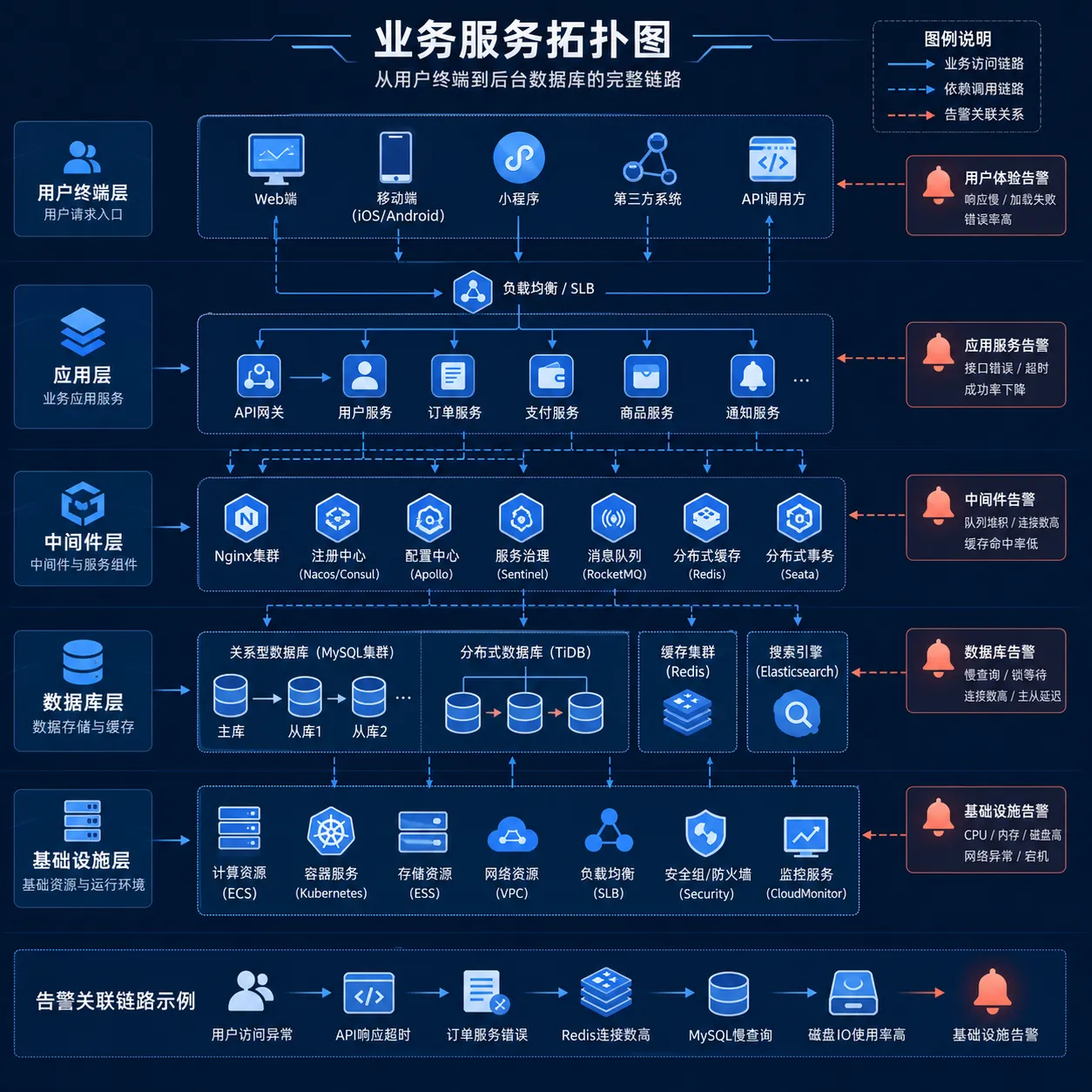
This e-book introduces how business service relationships connect users, business processes, applications, middleware, databases, virtual resources, networks, storage, physical servers and machine room facilities, combining these dependencies with real-time health, alerts, configuration changes, responsibility assignment and business metrics.
Evolution from Resource Monitoring to Business Mapping
- Establish end-to-end business dependency chain,Correlate downstream alerts from the same fault into complete events,Determine handling priority based on business criticality,Evolve from resource monitoring to business mapping, root cause analysis, impact assessment and guided automation
How CloudSino Connects Infrastructure with Business Impact
CloudSino provides hardware component, power distribution and machine room environment evidence through DCOS, connects software resources, CMDB, ITSM and automation processes through iDCOS, and SmartBSM establishes business health, business topology, root cause analysis and business impact views.