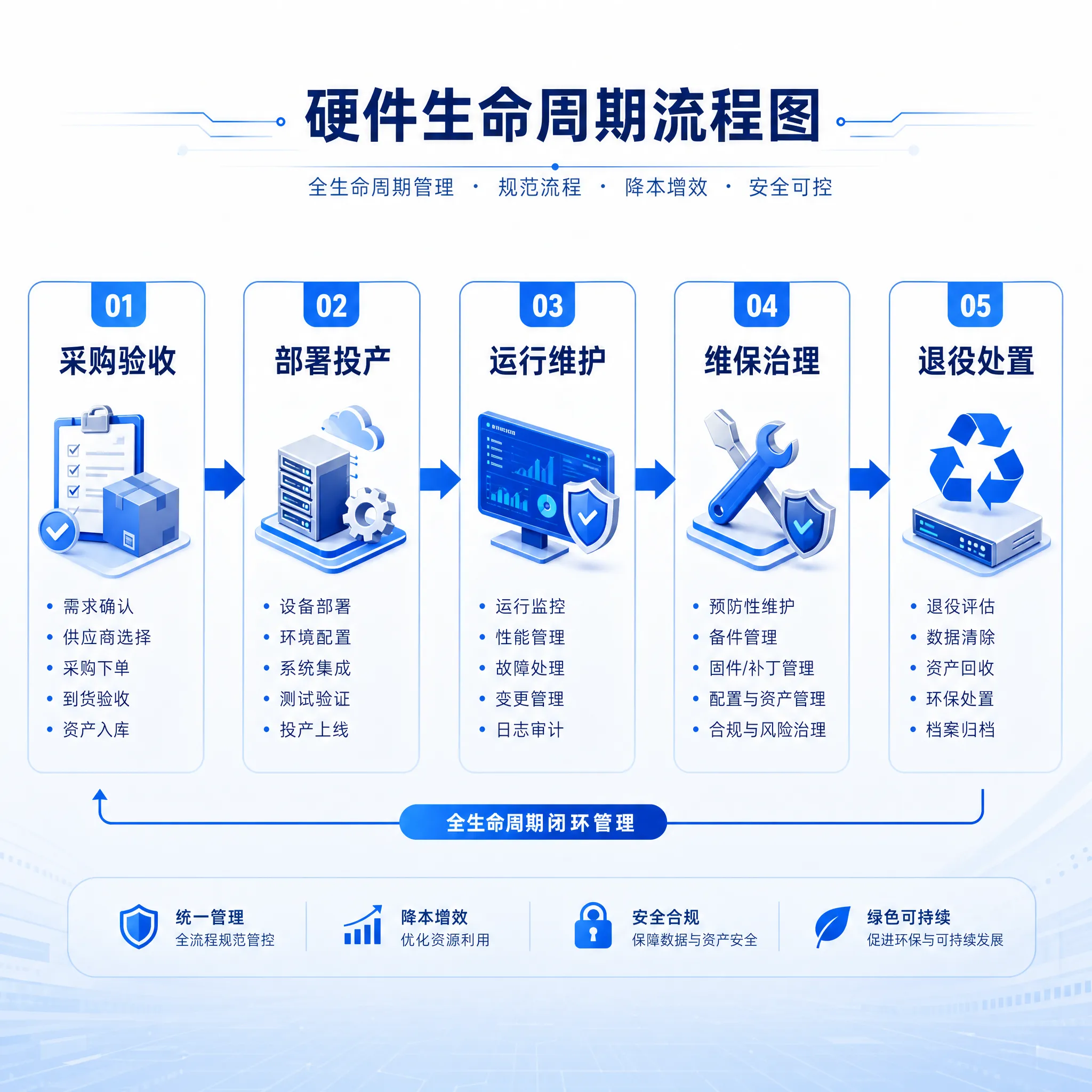
Hardware Full Lifecycle Management Guide
From Procurement Acceptance to Deployment, Maintenance Governance & Retirement
Why Hardware Lifecycle Management Cannot Stop at Asset Records
Data center hardware is often viewed as a set of devices that need to keep running, rather than an asset portfolio that simultaneously bears technical, financial, compliance and business service responsibilities. Hardware full lifecycle management bridges management gaps through continuous governance mechanisms: from planning procurement to final disposal, enterprises need to continuously maintain the authoritative identity, configuration, location, responsibility, operational status, business dependency, maintenance status, capacity environment and change history of equipment.
High-Risk Points for Lifecycle Control Failure
- Procurement approved complete configuration, but receiving team only checked quantity and serial number,Implementation team completed equipment installation but did not add business owner and maintenance attributes,Fault repair restored service but did not correct the changed configuration baseline
Eight Continuous Control Dimensions
- Identity: authoritative device identification,Configuration: technical specifications and change history,Location: cabinet, machine room, data center,Responsibility: technical owner, business owner, support team,Business dependency: supported business and services,Maintenance: contracts, response time, spare parts,Capacity: power, cooling, network, storage,Historical records: complete lifecycle evidence
Phased Implementation Path
This guide proposes a structured hardware full lifecycle governance model and explains how CloudSino DCOS, iDCOS and SmartBSM connect physical asset evidence, operations management processes and business service context.
How CloudSino Supports Hardware Lifecycle Governance
CloudSino connects physical infrastructure evidence, controlled operations processes and business service impacts through three mutually coordinated products. DCOS provides physical discovery, device status, configuration, energy consumption, capacity and location. iDCOS handles CMDB, ITSM, approvals, knowledge and automation. SmartBSM provides business dependency, health, root cause and business impact analysis.